

The complete guide
The Home Grower's Guide to EC, TDS and Nutrient Strength
The problem with mixing by the cap
Most people start the same way. You buy a bottle of nutrient, read the dose on the back, pour the cap into the watering can, give it a swirl and feed the plants. Sometimes everything thrives. Other times the leaves go pale, or the tips burn, or growth just stalls for no reason you can see. You followed the same instructions both times, so what changed?
Usually, the water did. Tap water is not blank. Depending on where you live, it already carries dissolved calcium, magnesium, sodium and a handful of other minerals before you add a single drop of feed. In some areas that starting load is barely noticeable. In others it is high enough that a standard dose pushes the solution well past where your plants want it. The bottle cannot know that, because the bottle has never met your tap.
Then there is what happens after mixing. Plants drink water faster than they take up the dissolved salts in it, so a reservoir left for a few days quietly concentrates. The level drops, the strength climbs, and the recipe you started with is no longer the recipe your roots are sitting in. None of this is visible. You cannot look at a tank and see 1.4 EC.
That is the whole reason a conductivity pen exists. It turns an invisible variable into a number on a screen.
How a conductivity reading works
The science is simpler than the jargon suggests. Pure water is a poor conductor of electricity. Dissolved mineral salts split into charged particles that carry current easily. So if you pass a tiny current between two contacts on a probe tip, the amount that gets through tells you how much dissolved salt is in the water.
That is electrical conductivity, or EC. More dissolved nutrient means a higher reading. It really is that direct.
The one thing EC cannot do is tell you what those salts are. A reading of 1.6 could be a balanced feed, or it could be a tank with too much of one element and not enough of another, or it could be hard tap water with barely any nutrient in it at all. Conductivity measures the total, not the recipe. This matters mostly when something looks wrong and the number looks fine. In that case the answer is usually in your mixing routine, your water source or your pH, not in the meter.
EC, CF, ppm 500 and ppm 700
Here is where new growers get tangled, so it is worth being clear.
EC is the raw measurement, usually written in millisiemens per centimetre. CF is just EC multiplied by ten, so EC 1.8 equals CF 18. Easy.
ppm is where it gets messy. Parts per million is an estimate of total dissolved solids converted from the conductivity figure, and the conversion needs a multiplier. Two multipliers became common in the industry, giving the ppm 500 scale and the ppm 700 scale. The same water will show two different ppm numbers depending on which scale you use, and the gap is large enough to matter. Someone telling you online to feed at 800 ppm has told you almost nothing unless they say which scale they mean.
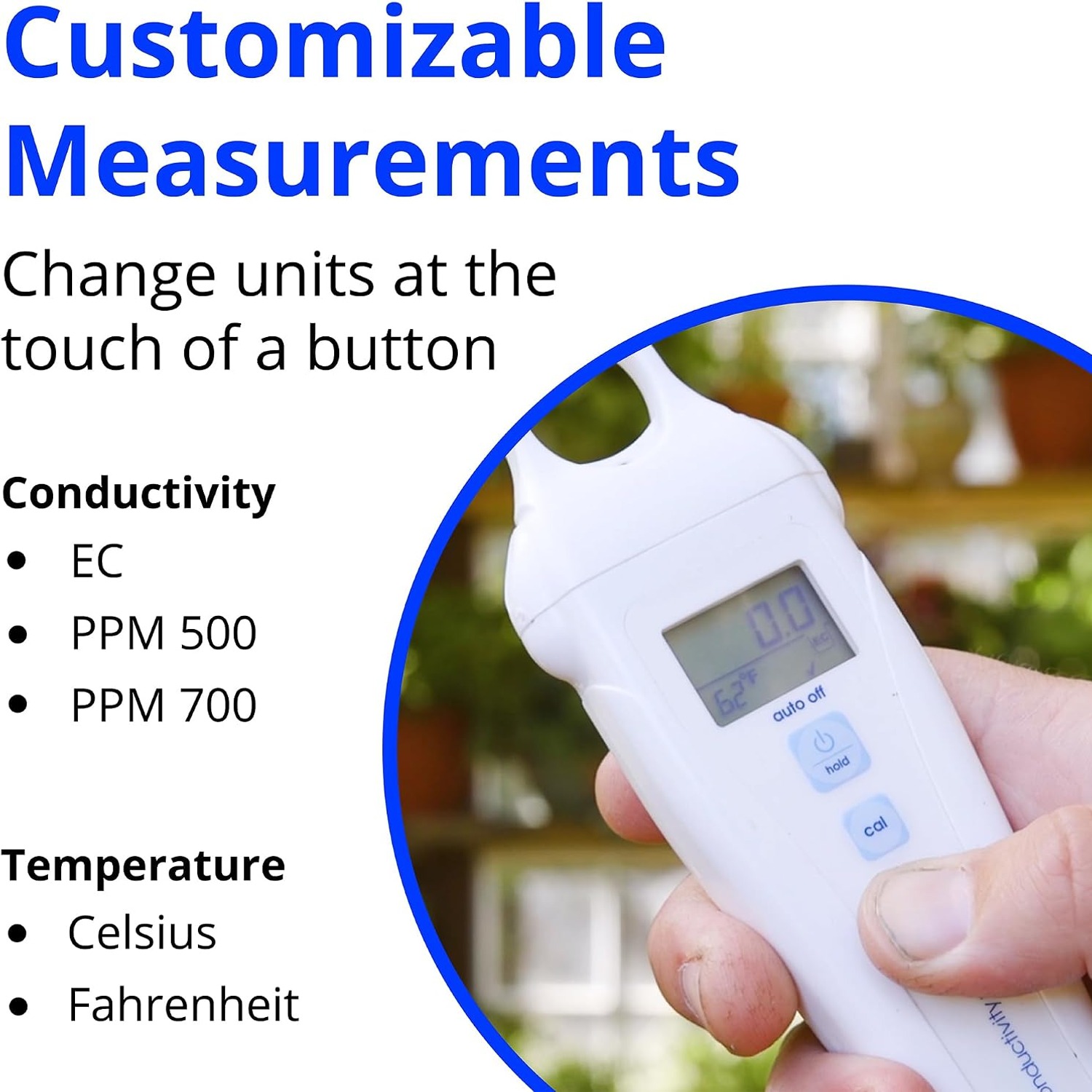
This pen displays all four, which is the practical fix. Set it to the unit your nutrient chart uses, and you never have to convert anything. If you switch nutrient brands later and the new chart speaks a different language, you change the pen rather than doing arithmetic over a reservoir.
Why temperature is on the screen too
A digital TDS meter that also reads temperature saves you a second tool, but the real value is interpretive. Water temperature affects how quickly roots take up both water and nutrient, and it affects how much dissolved oxygen the solution can hold. A cold reservoir in winter slows everything down. A warm one in late summer holds less oxygen and tends to push plants harder.
So when two tanks with the same EC produce different results, temperature is often the missing piece. Having both numbers in front of you builds the mental model faster than either one alone. The listed upper temperature range on this pen is 50 degrees Celsius, which comfortably covers normal growing conditions.
Who gets the most out of one
Anyone running a hydroponic system benefits immediately, because in hydroponics the solution is the only food source and small drift shows up quickly. If you are growing basil, lettuce, rocket, spinach, tomatoes or cucumbers in a recirculating setup, a nutrient strength tester moves you from guessing to knowing in about a week of use.
Container growers using liquid feed get a quieter benefit. You may only test the feed water before it goes on, but that is enough to catch an over-strength mix before it reaches roots. People with very hard or very soft tap water get the biggest surprise of all when they first measure their baseline.
It is less essential if you grow in rich soil beds and rarely use liquid feed. There, the soil buffers most of what you do, and the number tells you less.
Building a simple routine
Start by testing your tap water with nothing added. Write that number down. That is your floor, and every nutrient dose sits on top of it.
Mix your tank to the dose on the chart, stir it properly, then take a reading from the middle of the water. Stirring matters more than people expect, because nutrient can sit unevenly for a while after pouring. If the reading lands near the chart target, you know the dose suits your water. If it overshoots, your tap water was contributing more than the chart assumed and you dilute accordingly.
After that, check every day or two. If the number climbs while the level drops, the plants are drinking water faster than nutrient and a plain water top-up will bring it back. If the number falls, they are feeding heavily and you may need to refresh. Either way you are responding to what is happening rather than to a calendar.
A small notebook beside the reservoir, with date, EC and temperature, turns this into a pattern you can actually read after a month.
Looking after the pen
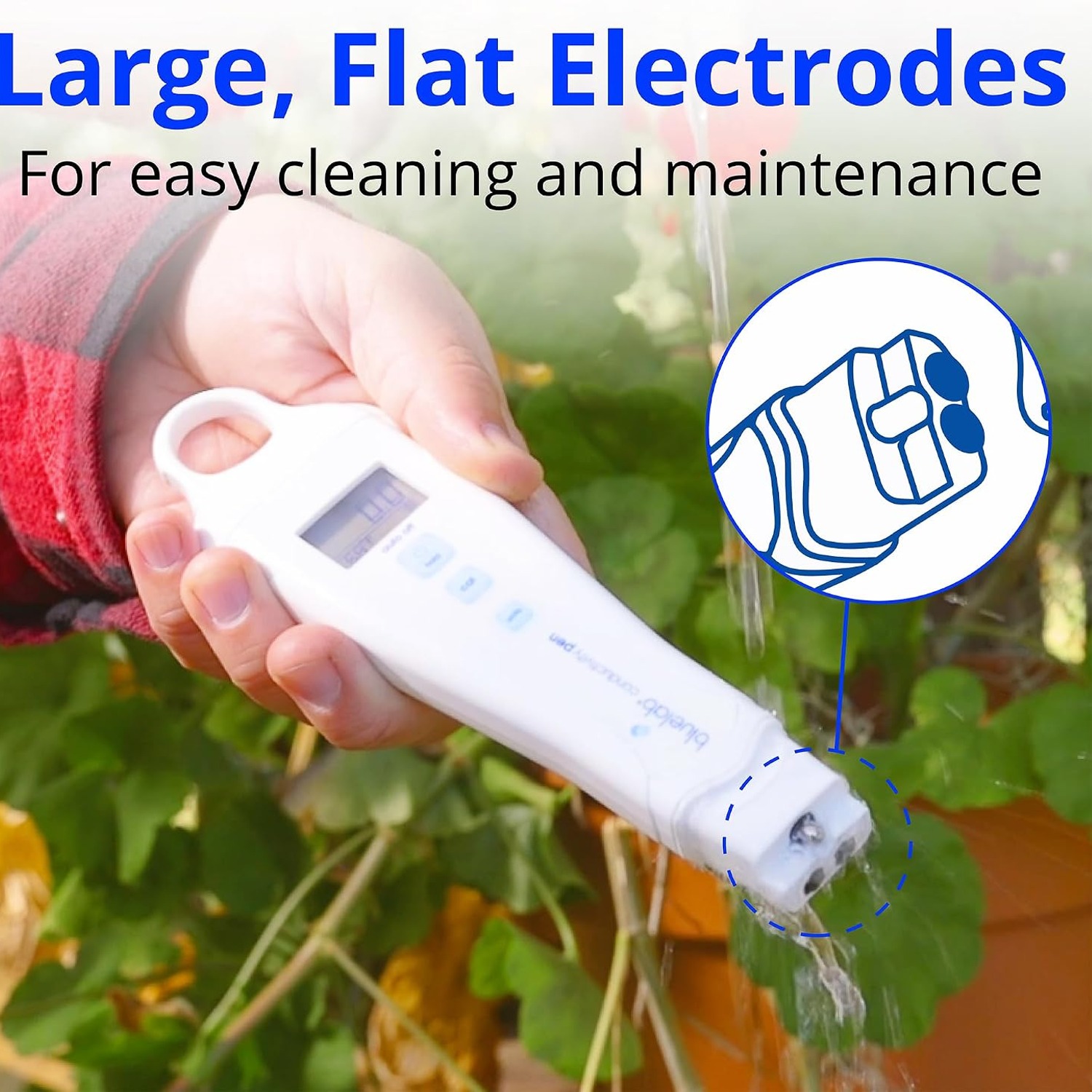
The single most important habit is rinsing the probe tip with clean water after every reading and shaking off the excess. Nutrient residue left to dry on the contacts is the usual cause of drifting readings. Regular cleaning is recommended for exactly this reason.
Do not scrub the tip with anything abrasive. Store the pen capped, dry and out of direct sun. If it is going into a drawer for the off season, take the AAA battery out first. The auto off function and low battery indicator handle most of the day-to-day battery worry, but a cell left in an unused device for months is asking for trouble.
A probe care kit is available separately if you want a dedicated cleaning solution. It is not included with the pen.
Pairing it with pH
Conductivity and pH are the two halves of nutrient management. EC tells you how much food is in the water. pH tells you whether the roots can actually absorb it. A perfectly dosed tank at the wrong pH can still produce deficiency symptoms, because certain elements lock out at the edges of the range.
Most growers who stick with hydroponics end up with one pen for each. If you are buying your first meter and can only pick one, the choice depends on your water. Unstable pH causes faster, more dramatic problems. Unknown mineral content causes slower, more confusing ones.
The short version
An EC meter answers a question you cannot answer by looking. It tells you how much dissolved nutrient is in your water, right now, in the unit your feed chart speaks. This pen reads EC, CF, ppm 500 and ppm 700 plus temperature, arrives factory calibrated so you can use it straight away, is waterproof, shuts itself off to save power, and runs on the AAA battery included in the box.
Test your tap water first. Mix, stir, measure. Rinse the tip afterwards. Do that for a few weeks and you will stop wondering why one crop did better than the last, because you will have the numbers that explain it.